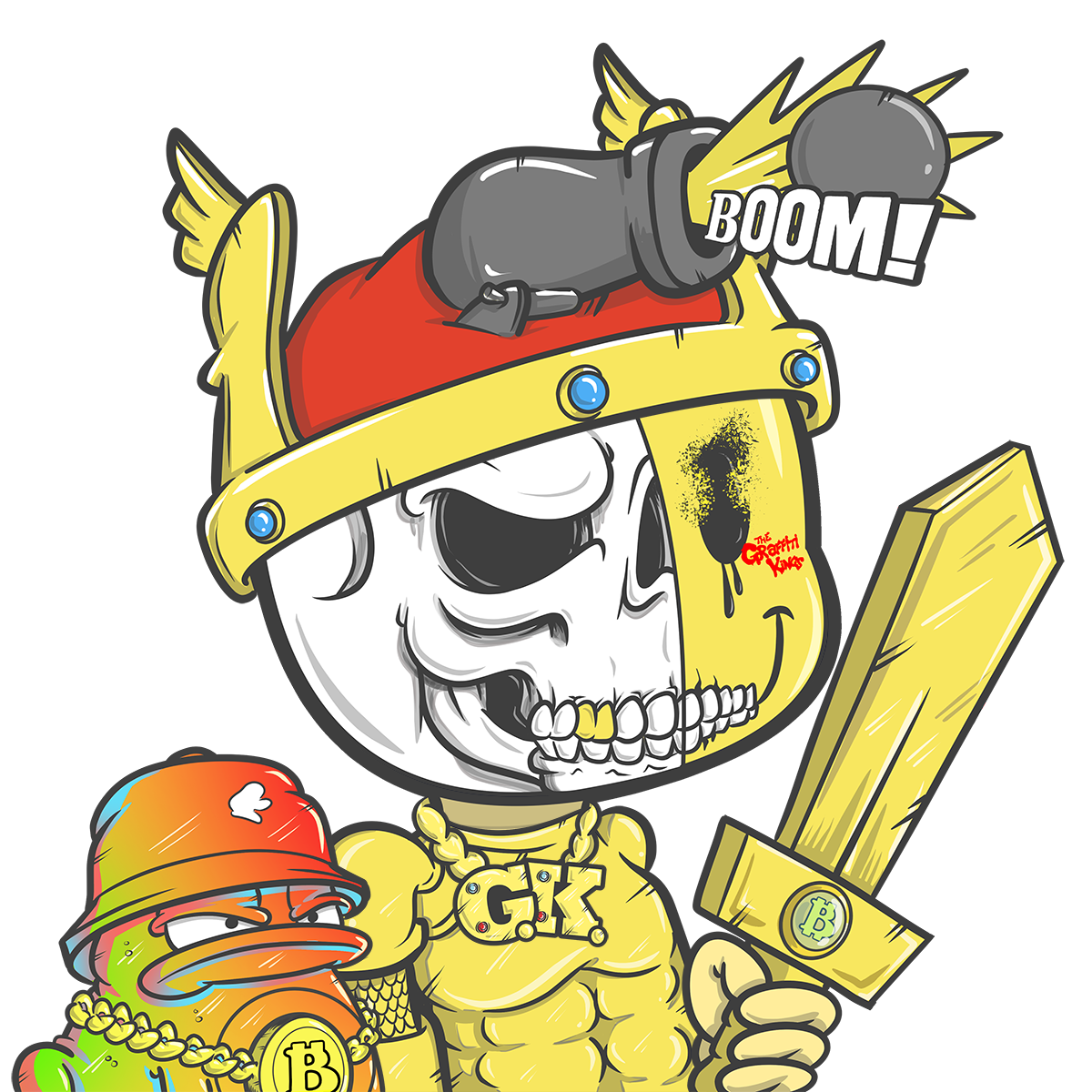
DARREN CULLEN / SER
Real-world Graffiti Kings founder, SER identity, Web3 architect, and W81 legacy root.
| Canon Status | Real-root figure / lore architect |
| Known As | Darren Cullen, SER |
| Root Movement | Graffiti Kings |
| Origin Layer | London graffiti, BMX, skate, UK hip-hop, pirate radio |
| Archive Role | Founder, Forge-Master, Architect of legacy |
| Web3 Layer | GKniftyHEADS, GraffPUNKS, Crypto Moonboys |
| Primary Canon Source | W81 archive |
Overview
Darren Cullen, known in the archive as SER, is one of the real-world roots of the Graffiti Kings, GKniftyHEADS, GraffPUNKS and Crypto Moonboys mythology. In W81 he is not treated as a simple biography entry or a flat founder note. He is recorded as a real artist whose lived history becomes one of the load-bearing origin layers of the entire universe.
The W81 archive frames the project as something that did not begin with a whitepaper. It begins with spray cans, trains, walls, BMX, skateboarding, pirate radio, UK hip-hop, South London pressure, and the decision to build culture without waiting for permission. Darren’s role sits at the centre of that claim. The archive repeatedly presents him as the founder of Graffiti Kings, the SER identity behind the early street movement, and the person who carries the old graffiti machine into the Web3 structure.
This page therefore separates two things. The first is the real-root record: Darren as an actual graffiti artist, founder and culture-builder. The second is the W81 lore translation: Darren as the Architect, Forge-Master, SER-Shard origin and legacy carrier whose street history becomes symbolic infrastructure inside the year-3008 universe.
Street Root
W81 places Darren’s origin inside the early 1980s London culture mix: BMX, skateboarding, the first waves of UK hip-hop, graffiti writing, sound-system pressure and pirate-radio self-broadcasting. The archive presents Graffiti Kings as a culture that learned by doing, not by waiting for approval from galleries, schools, brands or institutions.
The street root matters because the whole Moonboys universe treats graffiti as the first permissionless memory system. A wall could be written on without asking the authority that owned the wall. A train could move the mark through the city. A pirate radio transmitter could broadcast from a tower block without permission from established media. These behaviours become the conceptual ancestors of chain memory, token ownership, faction identity and unbuffable digital art.
In that reading, Darren’s early graffiti life is not background colour. It is the first protocol. The archive does not treat Web3 as a separate invention that replaced graffiti. It treats Web3 as the next wall. The old act was to write on the city. The new act is to write on-chain.
SER Identity
The name SER functions in W81 as both a writer identity and a symbolic root-key. The archive repeatedly links SER to the birth of the Graffiti Kings line, the GraffPUNKS attitude and the GKniftyHEADS digital continuation. SER is not only a tag; inside the larger mythology it becomes a shard, a recovery signal and a memory anchor.
Several W81 passages frame the SER layer as the place where real graffiti history becomes coded into the future. The SER-Shard language turns the old writer identity into a mythic object: a compressed fragment of the original London subconscious, a hard-root trace from the pre-chain world. It is the symbolic proof that the digital saga did not invent itself out of nothing. It came from someone writing first.
This is why the archive calls Darren the Architect and, in other places, the Forge-Master. Those titles are not replacements for the real person. They are lore translations of the same position: founder, builder, origin carrier and bridge between physical walls and digital permanence.
Graffiti Kings
Graffiti Kings is the street machine from which the wider archive grows. W81 describes it as a real culture line with decades of struggle, visibility, painting, commissions, recognition, and refusal to disappear. It is not presented as manufactured lore for an NFT campaign. It is the credibility base. The archive’s position is blunt: credibility in Web3 cannot be bought; it has to be earned, and GK earned it through years of work before blockchain was part of the conversation.
Darren’s founder role matters because the wider lore constantly returns to a simple contrast: the mundane, centralised, creatively bankrupt world against the bigger, bolder, louder GK signal. Graffiti Kings becomes the proof that this universe has a lived street origin. GKniftyHEADS and GraffPUNKS inherit that proof. Crypto Moonboys turns it into a long-form universe.
Within the timeline structure used elsewhere in W81, the earliest epoch is the Golden Age of Graffiti: the real-world London street period, the foundation of GK, and the argument that graffiti was already a kind of public blockchain before anyone used that language. A wall was public. The mark was visible. The city tried to buff it. The artist returned. That cycle becomes one of the deepest mechanical metaphors of the entire project.
Culture Layer: BMX, Pirate Radio, Hip-Hop and Aerosoul
The Darren / SER record cannot be reduced to painting. W81 keeps surrounding GK with the culture that formed it: BMX riders, skaters, South London crews, pirate radio, early UK hip-hop, record-label energy, DJs, tower-block transmitters and the raw need to make a signal louder than the official channels allowed.
This is why the music page, mechanics page and NFT page all connect back to the same root. Graffiti is visual sound. Pirate radio is aerosol without paint. A tag, a track, a transmitter and a token all perform the same basic action in the archive: they announce presence. They say the system did not grant permission, but the signal still exists.
W81 also uses the term Aerosoul to explain this deeper layer. Aerosoul is not just a style. It is the spiritual memory inside the mark. It is the thing that survives when a wall is painted over, when a platform changes, when a market moves, when a chain forks, or when a culture gets copied by people who were not there.
Web3 Pivot
W81 describes the Web3 move as a revolution reborn rather than a clean break. Darren and the Graffiti Kings line move from local back-alley tags and physical walls toward global metaverse walls, on-chain identity, NFTs, phygital objects, community ownership and digital memory systems. The archive’s claim is that this is the same rebellion using new tools.
GKniftyHEADS becomes the Web3 continuation of the GK root. GraffPUNKS becomes the sharper ideological street-radio signal. Crypto Moonboys becomes the larger saga, allowing the graffiti root to expand into characters, factions, games, rewards, relics, burns, missions, lore pages and future-history transmissions.
In this structure, Darren is not only the founder of an old-world art crew. He is the person who drags the machine forward. W81 describes this move as rebranding, re-imagining and birthing a wider ecosystem, but the key point is continuity. The paint does not stop. It changes surface.
Lore Role: Architect and Forge-Master
Inside the fiction layer, Darren / SER is translated into a mythic architect. W81 calls him a real-world architect of legacy, the Forge-Master, and the origin figure whose street movement becomes chain myth. This does not mean the page should invent fantasy biography over the real person. It means the archive treats his real history as source material for the fictional universe.
The Forge-Master image is direct: the first block is hammered with a spray can in one hand and a private key in the other. That is the cleanest W81 summary of Darren’s role. He stands at the point where physical authorship becomes digital authorship. He is the bridge between the tagged wall and the tokenised archive.
The SER-Shard extends this role into the far future. In the year-3008 reading, the old London signal becomes a recovery key buried inside the Grid. The future characters, factions and resistance groups do not simply admire the past. They rely on it. SER becomes proof that the system had an origin before the Grid tried to optimise culture into sterile order.
Documented public record: beyond the W81 archive
This real-world profile now connects to a separately sourced chronology of Darren Cullen / SER and a press, auction and social-source directory. The sources allow readers to distinguish press coverage, Cullen's own memories and project-authored lore.
In interviews Cullen described the early Croydon writing scene, how SER developed from the South East Rockers name, youth workshops in Mitcham and legal murals at Wallington station. The railway work and its claimed wider impact are recorded as his first-person account, not independently proven project statistics. FAD interview (2012); Page Common interview.
More securely dated external records include the ITV London Tonight cab commission (2012), two Ewbank's auction catalogue lots (2016, both unsold), EXTREME's 2019 production credit and Blockleaders' 2022 WAX feature.
The 2012 arrest and Olympic-venue restrictions were covered by contemporary newspapers; they are reported as allegations and disputed bail conditions, not evidence of guilt. The documented history presents the reporting alongside his own statements without inventing a court outcome. This record remains separate from the fictional role of the SER figure within the Grid.
Graffiti Queens: a documented 2021 exhibition
Contemporary Crypto Briefing reporting identifies Darren Cullen as Graffiti Kings founder and organiser of the April 2021 Graffiti Queens event in Decentraland, curated by Crypto Yuna. Artist Soul'D's first-person account confirms the exhibition was accessible as a virtual skate-park gallery. The dedicated history preserves differing artwork totals and participants' independent accounts, while the WAX registry documents the distinct NFT account system.
Connecting SER's history to Charlie Buster
Charlie Buster's own published biography links his early professional development to Darren Cullen and Graffiti Kings work. The artist history and Saatchi catalogue and web/source directory provide a separate, dated trail for Charlie's art and projects. These are independently identified artwork listings and first-party recollections, not a reason to import unsupported client lists into SER's own biography.
Canon Boundary
This page is built from the W81 archive’s framing of Darren Cullen / SER. It should not be expanded with unsupported dates, claims, client lists, personal details, external biographical assumptions or unrelated public information unless those details are added to the project archive and reviewed as canon.
Future edits should preserve the page’s split structure: real-root figure first, lore translation second. Darren should not be written as a purely fictional character, and he should not be flattened into a generic founder profile. In this wiki he is the root builder whose lived graffiti history becomes the architecture of the GKniftyHEADS, GraffPUNKS and Crypto Moonboys memory system.
The rule is simple: no invented biography, no unsupported hype, no short stub. Darren / SER pages should remain full long-form records of how the old wall became the new chain.