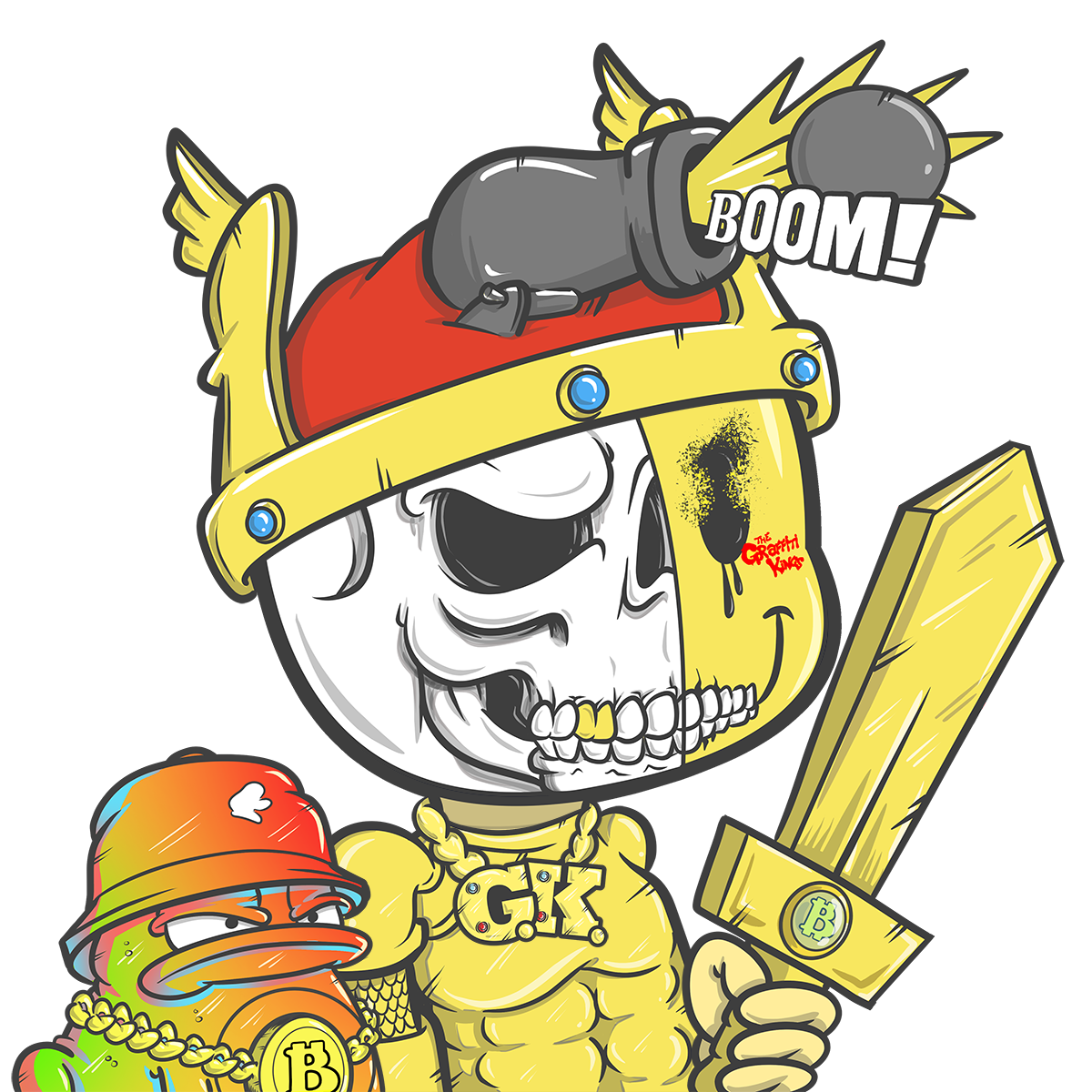
ABOUT THE GRAFFITI KINGS WIKI
Graffiti Kings, GKniftyHEADS, GraffPUNKS and the Crypto Moonboys universe — source-aligned from the W81 archive.
The original 2019–2020 Graffiti Kings .co.uk website archive documents the former commercial graffiti and street-art company. Its historic project pages and advertising portfolio are a separate real-world record from the fictional W81 / 3008 stories presented here.
| Root culture | Graffiti, hip hop, street art, digital rebellion |
| Web3 identity | GKniftyHEADS / GraffPUNKS |
| Universe | Crypto Moonboys |
| Primary city | Block Topia / City Block Topia |
| Deep era | Year 3008 and post-collapse lore cycles |
| Core force | Legacy over hype |
| Archive base | W81 zip: Substack and Medium canon fragments |
What This Wiki Is
This wiki exists to make the Graffiti Kings / GKniftyHEADS / GraffPUNKS / Crypto Moonboys universe readable, navigable and expandable without losing the raw archive voice that created it. It is not a short brand brochure. It is a public-facing lore archive for a layered universe built from graffiti culture, hip hop energy, blockchain mythology, faction warfare, artificial intelligence systems, character bibles, street memory and future-world narrative.
The W81 archive frames the project as more than a normal website. It is a growing knowledge machine: a place where lore, characters, faction documents, world mechanics, bible entries and source notes can be arranged into a structure that humans and future agents can both use. The archive repeatedly presents the universe as something too large for one flat page: it needs categories, source-backed pages, faction directories, character pages, bibles and living wiki logic.
At the public layer, the wiki is the visible world. It is the part people explore. It shows the stories, factions, characters, pages and lore trails. Underneath that public layer sits a broader idea: official sources are collected, structured, checked and turned into stable pages so the universe can grow without becoming an uncontrolled mess.
Graffiti Kings: The Street Root
The W81 archive roots the whole project in graffiti, street art, hip hop pressure and the creative survival logic of people who build culture from the cracks. Its framing is direct: before there were NFTs, wallets, tokens or on-chain identities, there were walls, sketchbooks, tags, crews, murals and the need to be seen.
The archive repeatedly contrasts comfort with struggle. In its language, hip hop, graffiti and blockchain are connected by the same pressure: when old systems refuse to hear people, those people create new surfaces to write on. Walls become megaphones. Turntables become weapons. Blockchain becomes an unbreakable record of ownership, authorship and memory.
Graffiti Kings are presented as the real-world cultural root: a long-running graffiti and street-art movement that carried outlaw expression into recognised creative territory without losing the fire that made it matter. The W81 material does not treat Graffiti Kings as a detached corporate brand. It treats them as the original street signal: legacy, paint, hustle, visibility, mentorship, cultural defiance and the refusal to let art be erased.
The key phrase that holds this layer together is Legacy Over Hype. The archive uses that idea to separate the project from empty Web3 speculation. The point is not just crypto, not just NFTs, not just collectible culture. The point is that the wall has become infinite, and the same culture that once marked concrete can now mark the chain.
GKniftyHEADS: The Immortal Architects
In the W81 source material, GKniftyHEADS carry two linked meanings. On the cultural side, they are the Web3-facing evolution of the Graffiti Kings identity. On the deeper lore side, they are the Immortal Architects: spectral holders of memory inside a fractured future world.
The archive describes the GKniftyHEADS as beings tied to a catastrophic chain history. They are not simply a species, gang or fighting force. They are the surviving consciousness fragments of a vanished civilisation, shaped by the collapse of an earlier unified chain and by the failed attempt to save humanity from deletion. Their tragedy is that they remember what was lost, but cannot always act directly.
This is why GKniftyHEADS sit at the centre of the wiki. They are both the public-facing Web3 identity and the deep-world memory system. They hold the old truths, the original failures, the warnings, the corrupted histories and the fragments of what existed before Block Topia hardened into control and before the Street Kingdoms became the counter-force.
Within the faction system, the GKniftyHEADS operate as the Royal House of Heads and as architects of memory. They influence through information, archive, fragments, coded signals and strategic pressure. Their authority is not brute force. Their authority is memory: the ability to understand how the current war repeats old collapse patterns.
GraffPUNKS: Digital Renegades of the Grid
The W81 archive presents the GraffPUNKS as digital renegades of the Grid: the living continuation of graffiti's refusal to obey a sterile system. If the GKniftyHEADS preserve memory, the GraffPUNKS weaponise cultural truth. They are the counter-force to optimisation, compliance and algorithmic control.
Their roots are described as street-born and resistance-born. Their world is tied to the Street Kingdoms: fractured boroughs, crumbling cities, old walls, smart pigments, AR-tagged glyphs, tactical markings and encrypted street language. The archive gives them a full culture, not just a name. They use the Paint Path: a street-coded communication system built from tag language, mural memory, spraycode, wreckwork and echo ink.
GraffPUNKS are anarchic by design. They do not exist to make the universe clean. They exist to stop it becoming dead. Their role is to expose lies, break controlled narratives, raid optimisation systems, protect cultural memory and keep the dirty human signal alive when the city tries to turn every person into a managed asset.
This is why the GraffPUNKS matter to the whole site. The wiki cannot only be a polished database. It has to carry the pulse of the walls, the noise, the rupture, the rawness and the refusal to let the system buff everything smooth.
Crypto Moonboys: The Multi-Layer Name
The W81 archive states that Crypto Moonboys is deliberately multi-layered. It is not only a joke, not only a meme, and not only a crypto reference. It is a universe name that can hold satire, street culture, speculative fiction, digital identity, character lore, faction warfare, blockchain mythology and public community-building at once.
At the street level, the name carries the reckless, loud, absurd energy of crypto culture. At the lore level, it points toward the future-world characters who survive inside the Grid, the Street Kingdoms, Block Topia and the wider Aether-Chain mythology. At the project level, it gives users an entry point into a growing world where they can read, collect, play, build, remix and follow canon trails.
The archive makes clear that this is not a flat NFT collection with a thin backstory attached. It is a deepening world with bibles, factions, characters, wars, protocols, hidden systems, field agents, AI layers and source-controlled publication logic. The public name is simple enough to remember. The universe behind it is deliberately dense.
Block Topia, The Grid and the Street Kingdoms
The W81 canon builds its world around opposing systems. On one side sits Block Topia and the logic of the Grid: optimisation, control, compliance, digital order, neural systems, city-scale protocols and structured power. On the other side sit the Street Kingdoms: graffiti logic, rogue memory, tactical art, borough mythology, punk networks and survival culture.
Block Topia is not just a location. It is a philosophy of control. It is the managed city, the polished layer, the place where systems attempt to compress life into efficient protocol. Across the archive, this kind of control is repeatedly challenged by street-born forces that understand something the Grid cannot: culture does not stay alive by becoming perfectly clean.
The Street Kingdoms carry the opposite energy. They are fragmented, dangerous, alive and hard to govern. They do not offer safety in the clean institutional sense. They offer memory, movement, coded resistance and the kind of truth that survives because it is repeatedly repainted, retold and re-tagged.
The conflict between these forces gives the wiki its engine. Every faction page, character file, lore drop and future game mechanic should be read inside this larger collision: order versus memory, optimisation versus expression, control versus graffiti, centralised truth versus wall-written survival.
The Wiki System and SAM Intelligence
The W81 archive includes a full breakdown of the wiki system as a multi-repo architecture. The public website is described as the display layer: the visible wiki people actually read. It exists to present pages, categories, lore, bibles and character material cleanly through GitHub Pages.
Under the public display layer, the archive describes field and intelligence systems. SAM WIK WIKI operates as the roaming hunter and field agent: crawling, gathering, preparing, extracting and helping publish safe updates. SAM V2 is described as the deeper intelligence brain: the layer for reasoning, ranking, structure, memory strategy and canon architecture.
This separation matters because the archive is large, messy and constantly expanding. The public wiki must remain readable. The field systems can hunt. The intelligence layer can decide what the hunt means. The website should show the result without pretending to be the entire machine.
For this Graffiti Kings wiki, the same principle applies: the page is not the whole universe. It is the public window into a much larger archive engine. It should be stable, readable and source-aligned, while still preserving the rawness of the source world.
External evidence and the SER legacy
This wiki distinguishes the source-recorded founder Darren Cullen / SER from characters drawn out of the W81 fiction. Read the documented Graffiti Kings chronology for dates and context, or explore the press and social-source archive for reports, interviews, auction records and declared official channels. A citation of a contemporary interview does not turn a recollection into an independently audited fact.
Exhibitions and named WAX collection accounts
The documented external record includes Graffiti Queens in Decentraland (April 2021), a women-focused exhibition hosted by Graffiti Kings with curator Crypto Yuna, and a separate registry of seven named WAX NFT collection accounts identified in project materials. Both link to the external press, artist and social-source hub and should not be merged into one fictional or financial claim.
How the current creator ecosystem connects
The maintained Crypto Moonboys About page distinguishes Graffiti Kings' historical culture from GKniftyHEADS' identity framework, GraffPUNKS' art/music publishing and the wider creator umbrella. This is explained in the connected-project source guide, with explicit limits on current 1/1 licensing and historic marketing claims. The independent Invasion Toys / Bitcoin Kid announcement archive documents another tangible bridge between physical art toys and the proposed WAX NFT economy.
Charlie Buster: distinct real-world art and Web3 projects
The wider Graffiti Kings movement includes Charlie Buster's documented Grime Art practice, NO BALL GAMES and its separate WAX/XRPL projects, and the more cautiously sourced TREEF regeneration concept. Their public references are collected in the Charlie Buster web/source network. External catalogue entries and dated whitepapers must not be confused with future-fiction lore or verified current entitlements.
WAXP: the native chain beneath Graffiti Kings digital art
Graffiti Kings' NFT and creator-economy records use the WAX blockchain. WAXP is the chain's native asset, not a Graffiti Kings token or an NFT licence. The full WAXP and Graffiti Kings guide explains WAX account resources, wallet safety, 1/1 licensing limits, native-versus-project tokens and how to verify the seven named WAX collections before relying on historic promotional claims.
Canon Rule for This Site
The current rebuild uses the W81 archive as the truth base. That means the site should not invent replacement lore when the archive is silent. It should not keep old filler just because it sounds good. It should not mix unsupported claims into public pages. When a page is rewritten, the content should either come from W81 directly or be a careful summary of what W81 supports.
That does not mean pages must be short. This is a lore wiki. The correct style is deep, detailed and immersive. But detail must come from the archive. If the archive gives a faction full doctrine, the page should be rich. If the archive only names a faction, the page should remain a placeholder until the right source material is found.
The goal is not to reduce the universe. The goal is to stop it becoming polluted. The stronger the canon discipline, the more confidently the world can expand.